Email remains the channel with the best return per real invested in digital marketing, provided it runs as a flow and not as an occasional blast. This guide shows how to structure nurture sequences that educate, warm up, and sell, without relying on one-off, last-minute campaigns.
A nurture flow is not a campaign
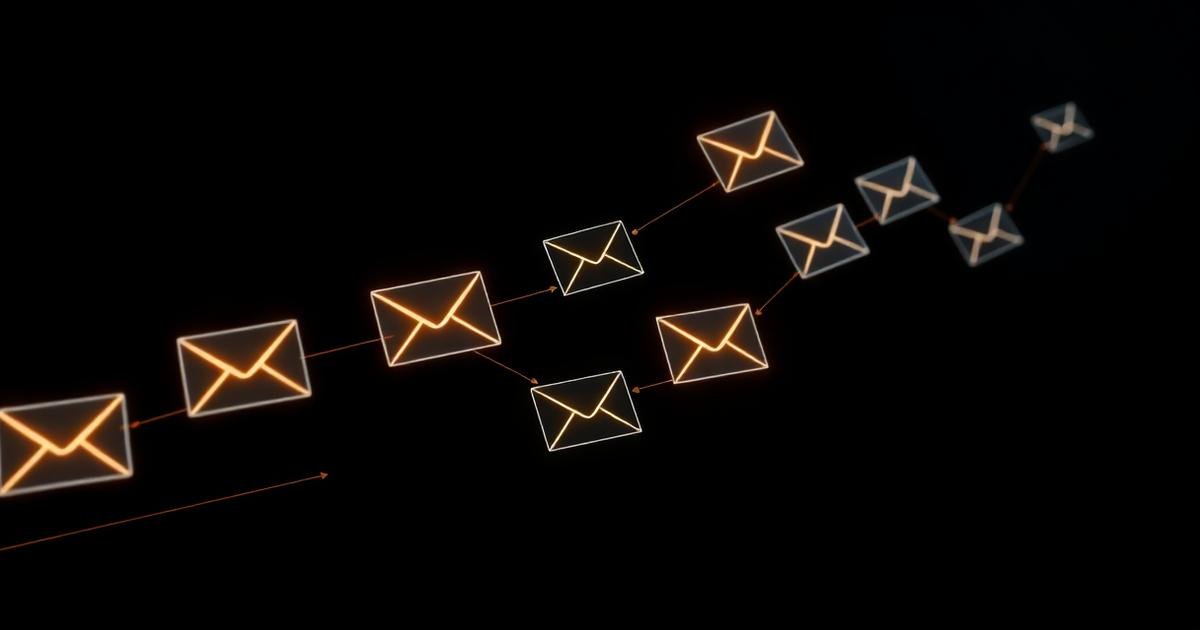
A campaign is a one-off send to an entire base, at the same moment, with the same message. A flow is an automatic sequence, triggered by an individual event (a signup, a download, a cart abandonment) that follows each person at their own pace. Operations that live on campaigns depend on recurring creative work; operations with flows sell every day without extra effort.
The flows every operation should have
| Flow | Trigger | Objective |
|---|---|---|
| Welcome | new signup or lead | introduce the brand and the first offer |
| Top-of-funnel nurture | free resource download | educate and qualify before selling |
| Cart abandonment | checkout started but not completed | recover a sale in progress |
| Post-purchase | purchase completed | reduce anxiety and prepare an upsell |
| Re-engagement | no email opened in 60-90 days | recover engagement or clean the base |
| Launch | set commercial date or event | concentrate demand into a short window |
Each flow is triggered by an event recorded on the marketing automation platform, linked to the lead capture form and to browsing or purchase history.
How to structure a sequence that converts
- Define a single objective for the sequence: one action, not several.
- Map out four to seven emails, each with a specific purpose within the arc.
- Start with the pain point or context, not the offer, in the first two emails.
- Introduce the offer explicitly starting from the third or fourth email.
- Address real objections in the middle emails, backed by concrete proof.
- Close the sequence with genuine urgency: a deadline, a limited spot, or a condition that truly ends.
Objection handling at this stage follows the same logic as the guide to sales objections: name the doubt before it comes up, rather than waiting for the lead to ask.
Email copy: subject line, preview, and body
Subject line and preview work together
The subject line opens curiosity; the preview text (the line shown next to it in the inbox) completes the promise. Testing both together, not in isolation, is what really moves the open rate.
One email, one CTA
Every email should lead to a single action. Emails with three or four competing links dilute clicks and make it harder to read which offer actually worked. The foundation of persuasive messaging follows the same principles as the guide to sales copywriting.
Plain text outperforms heavy design
B2B nurture sequences and high-ticket offers tend to perform better in plain running text, without a heavy visual template. It reads like a personal email, not an ad, and that raises the response rate.
Metrics that show whether the flow is working
| Metric | What it reveals | Reference range |
|---|---|---|
| Delivery rate | list health and domain reputation | above 98% |
| Open rate | strength of the subject line and sender | 20% to 35%, varies by industry |
| Click rate | relevance of content and CTA | 2% to 5% |
| Flow conversion rate | how well the offer fits the journey stage | track per sequence |
| Unsubscribe rate | fatigue or mismatched expectations | below 0.5% per send |
To correctly attribute revenue generated by each flow, conversion events need to be configured properly; see the guide to GA4 conversion events.
How to keep the list healthy
- Confirm the email address at signup (double opt-in) to reduce invalid addresses.
- Remove or re-engage contacts that have been inactive for more than six months, periodically.
- Segment by behavior, not just demographic data.
- Authenticate the domain (SPF, DKIM, DMARC) before scaling send volume.
- Never buy a list: the damage to domain reputation outweighs any short-term gain.
Mistakes that hurt performance the most
- Sending only when there is a promotion, with no content consistency.
- Mixing an automatic flow with a manual campaign to the same base on the same day.
- Not segmenting by funnel stage, treating a new lead the same as a long-time customer.
- Ignoring the base's historically highest-engagement sending time.
- Never reviewing or turning off old flows that have lost relevance.
Checklist for a nurture flow ready to run
- Entry trigger defined and tested.
- Four to seven emails with an individually mapped purpose.
- Subject line and preview written and tested together.
- One single CTA per email.
- Real objections addressed with concrete proof.
- Open, click, and conversion metrics tracked per flow.
- List segmented by behavior and journey stage.
Conclusion
Conversion email marketing is not about sending more emails: it is about designing sequences that do the work of selling while the team is busy with something else. A properly nurtured base becomes the cheapest and most predictable channel in the entire funnel.
Frequently asked questions about conversion email marketing
What is the difference between a nurture flow and an email campaign?
A campaign is a one-off send to an entire list. A flow is an automatic sequence triggered by an individual lead's behavior, running continuously without new operational effort.
How many emails should a nurture sequence have?
Between four and seven emails is usually enough to move a lead from capture to offer. The complexity of the decision sets the number, not a fixed rule.
What is the best sending frequency?
Start with one send every two or three days in the initial sequence, then drop to weekly for the cold base. Track unsubscribes and complaints to calibrate.
How do I increase email open rates?
Work on a recognizable sender name, a short and specific subject line, preview text that complements the subject, and list hygiene. Sender reputation matters more than subject line creativity.
Is it worth removing inactive contacts from the list?
Yes. Contacts who have not opened an email in months drag down deliverability for the entire base. Run one re-engagement attempt and remove whoever does not respond.
Does email marketing still convert?
Yes, especially in the middle and bottom of the funnel, since it is an owned channel with no cost per impression and full control over the message and the timing of each send.

About the author
Kauára Bertoluci
Partner and Head of Strategy & Growth, KCLOCK
Marketing, tracking, and CRO strategist. Leads positioning, funnels, paid media, and measurement across KCLOCK's projects.
- #automation
- #nurturing
Want to apply this to your funnel with people who do it every day?
KCLOCK builds high-converting funnels, landing pages, websites, and e-commerce stores. We diagnose your current funnel and show you where the revenue you're leaving on the table is hiding.